U
CQI approved education centre logo


CQI Diploma

U502 - Management System Models


The CQI Diploma in Quality Management provides new and existing quality practitioners with the knowledge and skills to plan and manage an organisation's quality management function.  The qualification does this by developing a comprehensive understanding of the role of quality and the quality function within the whole organisation.


Students who successfully complete the 9 Diploma Units and have the required work experience will be eligible to apply for the CQI full membership.

Potential job roles include: Quality Manager, Quality Assurance Manager, Customer Service Manager, Operations Manager, Business Improvement Manager, Business Systems Manager, Senior Quality Manager, Quality Management Specialist/Consultant.

For information on how you can use these units in other CQI qualifications, download the CQI Qualifications and unit matrix.


THE PACKAGE

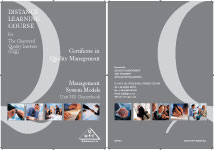
cqi diploma coursebook - unit 502   cqi diploma workbook - unit 502   cqi diploma textbook - unit 502
Course Book Workbook Text Book

The packages are stand alone private tuition packages which allows the delegate to work at their own pace through the preset training material.

The distance learning material is sent to you upon course registration. The packages include:

  • Coursebook - containing tutorial notes and information
  • Workbook - containing questions and answers
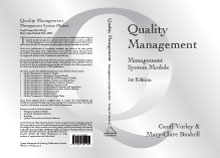
  • Text Book - 'Quality Management - Management System Models' by Vorley & Bushell
  • Sample exam paper
  • Tutorial support is provided by telephone, fax, e-mail or written correspondence as required. See QM&T Team
  • QM&T Newsletter with all the very latest QA news. Keeping you right up to date and informed on what is happening in the Quality Assurance field.

Unit 502 Syllabus

Unit 502

Management System Models

Unit Aim: To evaluate the commonalities and differences of the range of popular quality management standards and models in order to select a standard/model appropriate to a given organisation. To be able to evaluate the effectiveness and business benefit of a management system against selected standards and models. To be able to integrate standards and models appropriately.


On successful completion of this unit students will be able to:

  • Understand the use of quality models in business
  • Understand the role of standards in quality assurance
  • Understand the use of integrated management systems within organisations

Suggested assessment method: Assignment


Indicative content

Management system models and standards

• ISO9000 / 1 / 4

• Investors in People (IIP),

• EFQM Excellence Model

• Malcolm Baldridge National Quality Award

• Customer Service Excellence Standard


Standards

• Evolution of standards for product conformity and variety reduction, weights and measures, safety, and management systems

• Company standards


Other applications for standards and conformity assessment

• Product certification schemes

• CE Marking

• The role of Government, accreditation bodies, certification bodies, standards bodies, regulatory bodies, professional bodies, national and international quality award schemes, customers, consultants; interfaces.


Integrated management systems

• Common elements of management systems

- Policy

- Document control

- Responsibility and authority

- Audit

- Management review

• Principles required for the integration of management system standards to avoid replication of activities in the management process.

• Examples of standards that can be integrated into a single management system include some specific named examples of:

- Company standards

- Management system standards

- Regulations

- Sector standards

- Codes of practice

- Customer standards


Assessment of conformance with Models and Standards

• Methods used for assessing the integrity of quality system models including the EFQM RADAR approach.

• Regulatory standards


"));